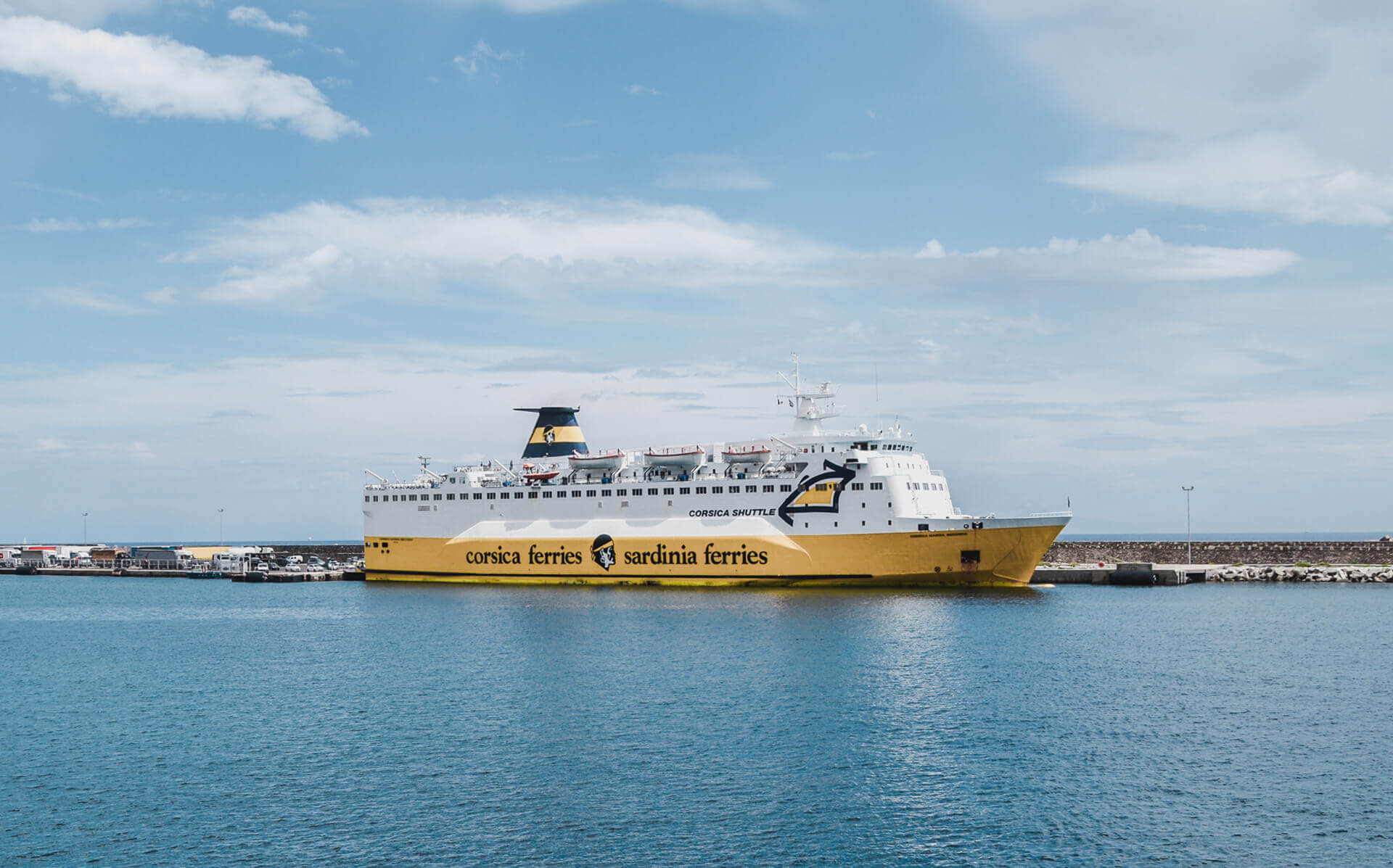
We have now been to Corsica six times, and each time we’ve had a car to get around in – a couple of times with a rental and four times with our own car. Whether you have a rental or your own car, I think my experiences can be useful if you plan to drive around this amazing island.
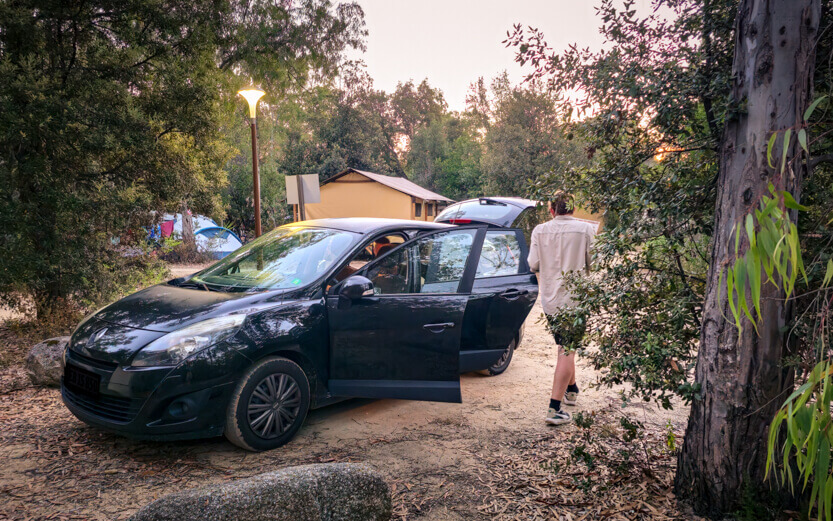
Make sure to allow plenty of time
All driving on Corsica takes longer than expected. For example, a trip from L’Île-Rousse to Aléria may seem straightforward – it’s only about 110 km. On a Danish motorway, you would expect to cover that in just over an hour. But on Corsica, the roads go through the mountains, so Google Maps estimates the driving time at around 1 hour and 45 minutes. In reality, it often takes even longer. Unless you’re used to mountain driving and skip the views, you should probably plan for around 2 hours.
Nerves on edge
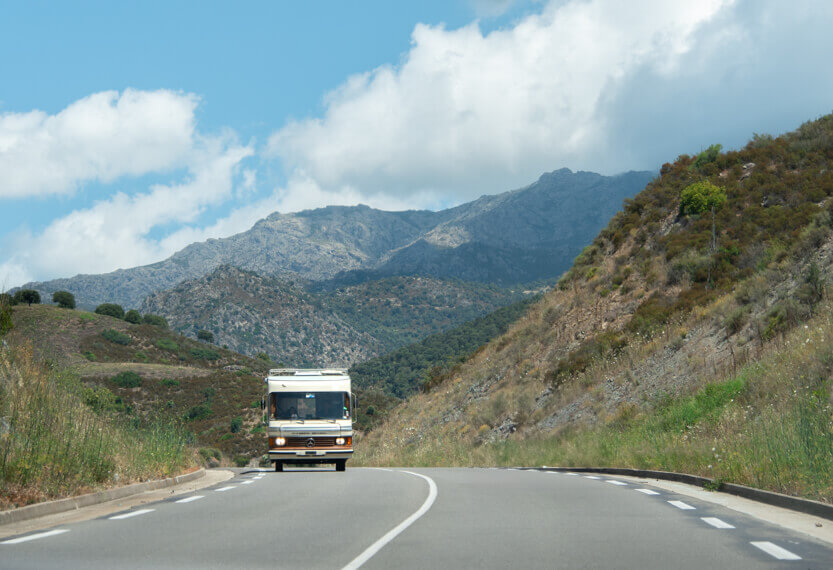
I consider myself a fairly competent driver, having driven in mountains multiple times around the world – and especially on Corsica. But even with my experience, some of the roads can require taking a deep breath before you drive.
The local islanders certainly have no problem speeding through the mountains, but as a Dane, it’s not common to drive up and down twisty mountain roads. My best advice is to drive at a pace that suits you and not let other drivers pressure you. Without knowing the exact number, several sources indicate that more people die on Corsican roads than in the rest of France. Take precautions and drive carefully, and you should be fine.
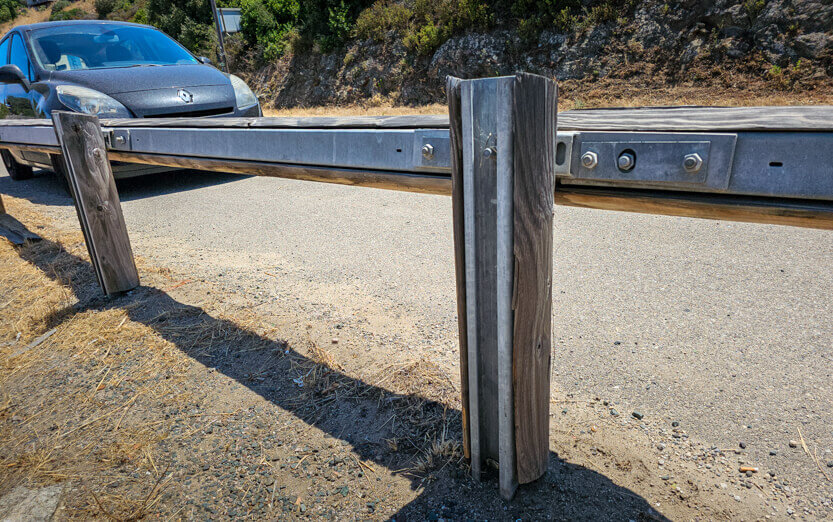
The guardrails are stronger than they look
In several places on Corsica, the guardrails are made of wood – or at least that’s how they appear. You don’t need to worry too much about whether they will hold, because behind the wooden facade is a steel structure that makes the guardrail strong. This solution was most likely chosen for aesthetic reasons, to make the barriers fit better into Corsica’s natural and rustic landscape while still preserving their protective function. This means that even though they look traditional and beautiful, they still have a solid underlying structure that can withstand quite a lot.
Special roads and experiences along the way
When driving around Corsica, it’s hard not to be breathless at the many beautiful landscapes and roads waiting to be explored. Here are some routes and experiences you might consider including – or skipping – in your travel plans:
The route through the Restonica Valley
A drive through the Restonica Valley is a once-in-a-lifetime experience – and that can be interpreted in more ways than one ;-). The road is narrow, winding, and clings to the cliffside, but it leads you to one of the most beautiful natural areas on the island. Here you’ll find fantastic hiking trails and stunning mountain lakes with crystal-clear water.
It’s important to note that the road can be challenging – very challenging – especially in peak season when many tourists flock here. Make sure to start early to avoid traffic and secure a good parking spot. Drive slowly and carefully – we’ve tried it ourselves, and believe me, it’s no fun to reverse a car on these narrow roads with a drop on one side, a mountain on the other, a cow crossing at the same time, and a car squeezing past. We still have trauma from that experience, even four years later.
The coastal roads
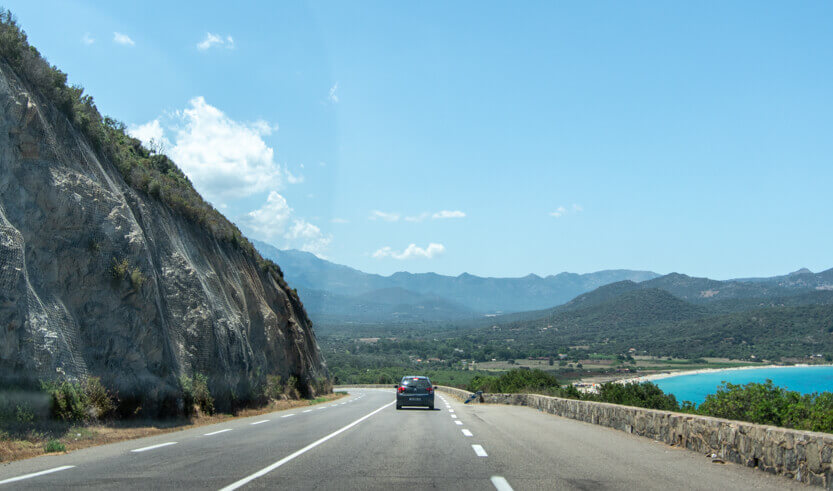
There are many coastal roads on the island, and a large number of them are extremely spectacular – it’s hard not to pinch yourself in disbelief at the beauty. We love the route from Bastia to L’Île-Rousse, but other routes, like Fautea to Solenzara, are also incredibly beautiful – so much so that you can easily forget you’re in Europe and not the Caribbean.
The smaller mountain towns
Many of Corsica’s mountain towns feel like they’re from another era. Towns such as Corte and Chiatra (and many, many more) are perfect for a stop to stretch your legs, enjoy a coffee, and experience authentic Corsica. Be prepared for steep and narrow streets, which can be a challenge to navigate by car – especially if you’re driving a larger model. Finding parking can also be tricky.
Corsica by car is an unforgettable way to explore the island
Corsica is a unique place, and driving here gives you access to some of the most remote and beautiful areas the island has to offer. Whether you’re winding through mountain roads, driving along the breathtaking coastline, or entering small charming towns, each trip is a new chance to discover Corsica’s magic. I would almost dare to say that it’s nearly impossible to experience Corsica in depth using public transport.
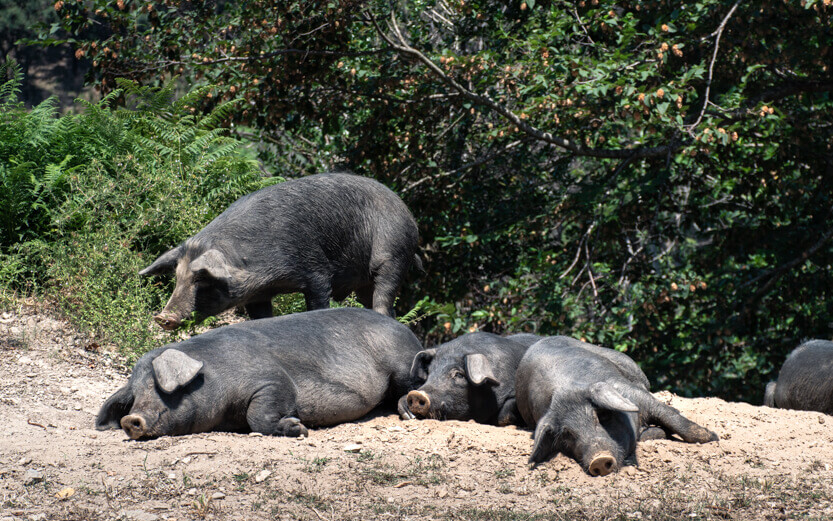
So, if you’re planning a trip to Corsica, don’t hesitate to drive your own car or rent one when you arrive. There’s no better way to experience the island than from the driver’s seat – enjoying the beautiful nature and the wild boars running around.
Coastal roads – beautiful, but slow
Driving along Corsica’s east coast offers a more relaxed journey with fantastic views of the Mediterranean. A great route that showcases this is from Bastia to Bonifacio, which follows the east coast via the RN198.
This road is one of the most direct and easiest main roads to drive on in Corsica, as it’s relatively flat and wide compared to the mountain roads inland. Along the way, you’ll pass beautiful beaches, charming coastal towns like Solenzara, and you can take detours to some of Corsica’s best sandy beaches, such as Plage de Palombaggia or Santa Giulia near Porto-Vecchio.
But even though the road is more direct, don’t expect motorway speeds. Traffic in the summer months can slow things down, and there are many small towns along the way with reduced speed limits.
Tips for driving along the coast
- Plan breaks. The journey can be long if you’re, for example, going from Bastia to Porto-Vecchio – luckily, there are plenty of beautiful beaches to stop at.
- Start early or later in the day if you want to avoid the worst traffic – this is especially true during the busy summer months.
- Watch out for animals and pedestrians in the small coastal towns – people often walk along the roads, which can get a bit hectic at times.
- Keep an eye on your fuel – there aren’t always stations nearby, so make sure to fill up.
Mountain roads – faster, but more demanding
If you want to cut down travel time – for example, between Aléria and Ajaccio (around 2 hours) – you can take a mountain route instead of the coastal road, which takes about 3 hours and 45 minutes. A good option is to take the N200 and N193 through Corte and over Col de Vizzavona, one of Corsica’s main roads that crosses the island from east to west.
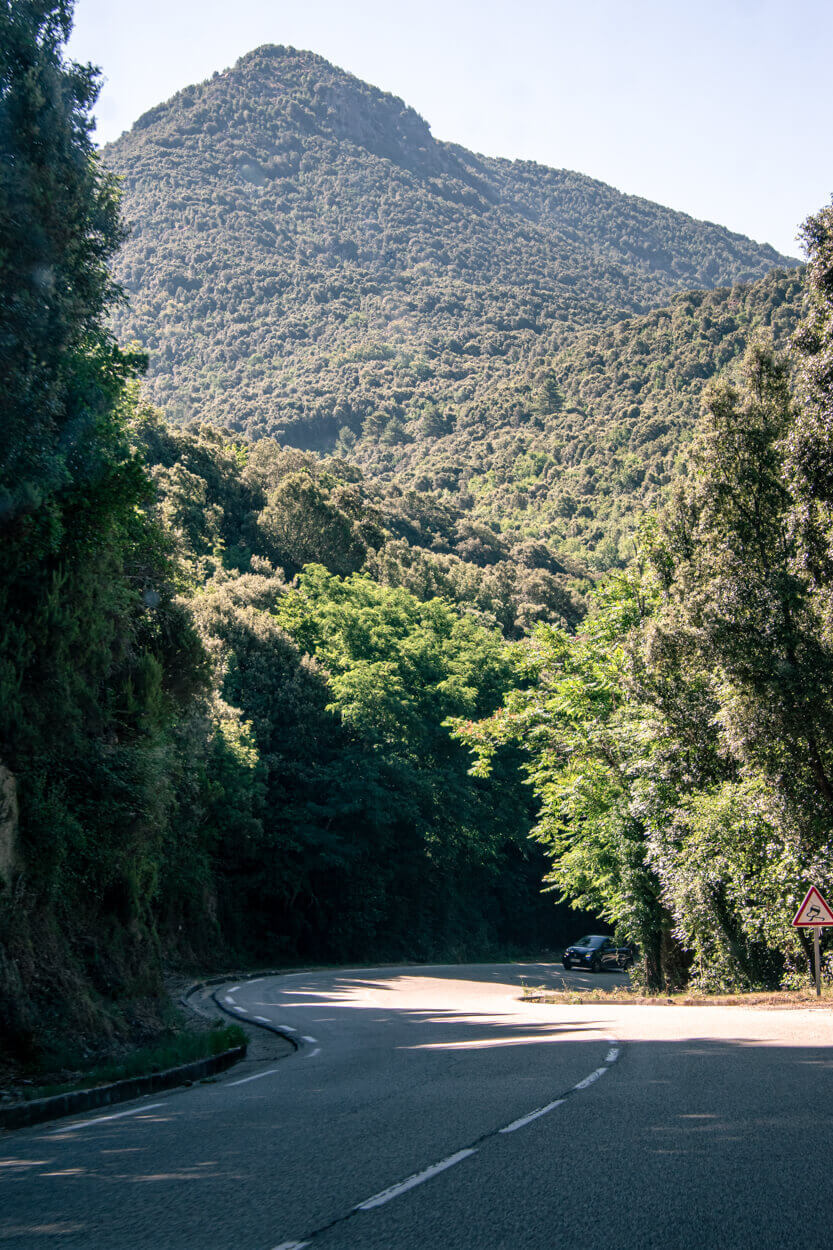
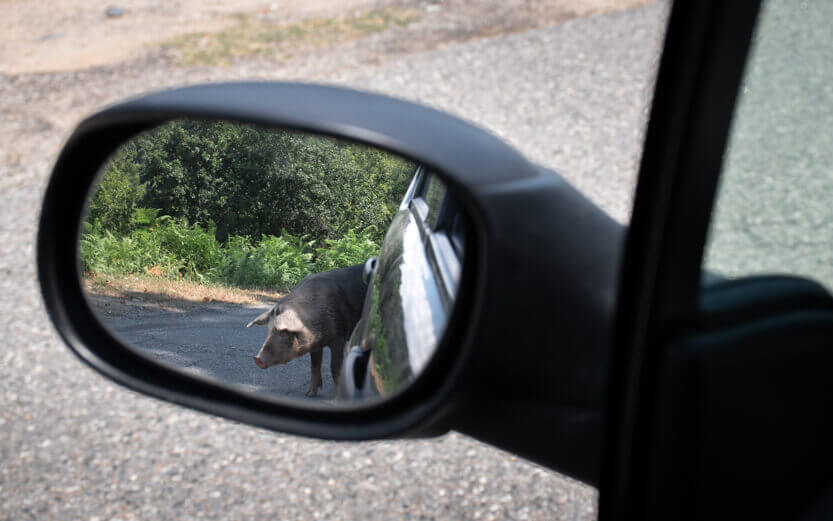
This route takes you through the Corsican interior with breathtaking mountains, deep forests, and the historic town of Corte, the island’s old capital. While the mountain route can be faster than the coastal road, be prepared for hairpin bends, narrow roads, and sudden encounters with free-ranging cows or wild boars. Note also that some locals drive up and down the mountains as if it were a straight highway – which can be a bit challenging for inexperienced Danish drivers (certainly for me).
Tips for mountain driving
- Drive slowly and safely – there are many sharp turns and narrow stretches.
- We usually try to avoid driving in the mountains after dark, as several roads aren’t lit.
- Just like when driving along the coast, remember to take breaks – there are countless beautiful spots for a well-deserved pause.
- For passengers with a fear of heights, it can help to focus on something other than the sometimes dramatic drops right next to the road. If possible, sitting on the side facing the mountain can feel safer.
Coastal roads or mountain roads?
Both types of roads offer fantastic experiences, and we usually drive along the coast as well as through the mountains. Both routes provide incredible scenery, but if I ever have to drive at night, I would prefer the coast – it’s more easygoing.
City driving in Corsica
Driving in historic city centers – narrow streets and sharp turns
Many of Corsica’s towns have historic districts where the roads were laid out long before cars were part of city life. This means narrow streets, sharp corners, and often one-way roads.
This doesn’t just apply to the smaller towns. If you’re driving in, for example, Bastia’s old town or Ajaccio’s historic center, you’ll quickly realize that precision and patience are key. We’ve now driven several different types of cars in Corsica, and I’d say that for city driving, a smaller car has definitely been the easiest.
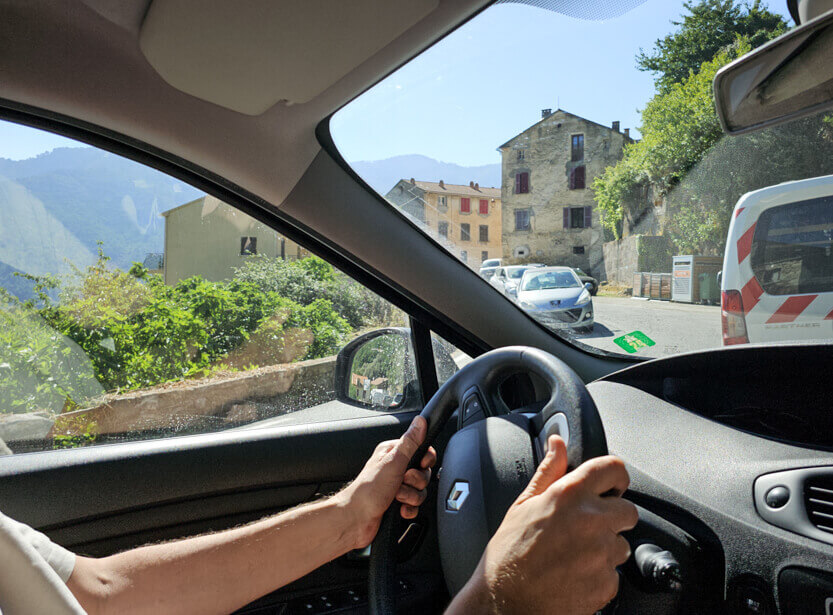
Tips for city driving
- If you have the option to drive a smaller car in town, do it – there isn’t much space to maneuver.
- Drive slowly and be prepared for sudden turns and pedestrians.
- If you’re using GPS, note that it doesn’t always account for whether streets are too narrow for cars, so pay attention to signage.
- Patience, patience – and more patience.
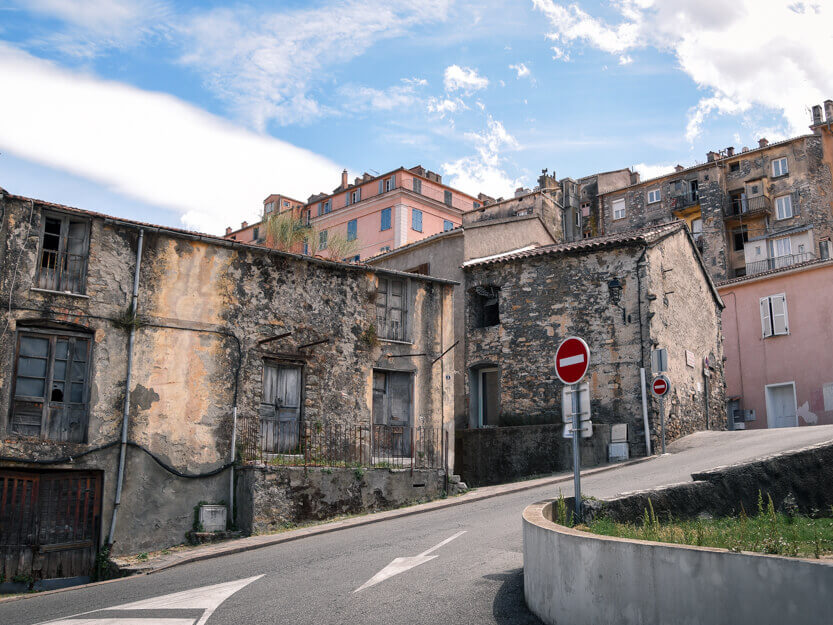
Beautiful mountain towns – authentic, but not car-friendly
Corsica’s mountain towns are often absolutely stunning to visit, but they can be tricky to drive in. Many are built on steep hillsides with narrow, winding streets where there’s often only room for one car at a time.
Driving through the small mountain towns can be a challenge, but parking is an even bigger problem.
5 quick tips
1. Don’t let yourself get stressed
Try to avoid getting stressed by the locals’ driving. They are experienced drivers on their island and often drive significantly faster than I would recommend. The locals are also used to the roads being winding and not necessarily very wide, but drive at your own pace – it will make the trip much less stressful. Locals also tend to drive very close behind you, which can be stressful, but from experience, they do this so they can quickly get around you when they want to overtake on the twisty roads – it’s rarely meant to annoy you 🙂
2. Take time to enjoy
Take time to enjoy your road trip – whether you’re driving through the mountains, along the coast, or through charming towns. Corsica offers extraordinary natural experiences and beautiful landscapes everywhere, so remember to slow down, take a deep breath, and really take it all in. It’s not just about getting there – it’s about enjoying the journey along the way!
3. Tunnels in the city
Bastia has tunnels on the main roads in and out of the city, but there are also roads that go around the tunnels, which can be a bit confusing at first. It’s actually very convenient, as it lets you avoid roundabout traffic in principle.
4. Avoid brake overheating
When driving up and down mountain roads, the brakes are used intensively, which can lead to overheating – especially in summer, when temperatures are high. Overheated brakes can lose efficiency, which can be dangerous on steep descents.
A good tip is to keep an eye out for signs that your brakes are becoming less responsive or smell burnt. If that happens, find a safe spot to pull over and let them cool down. They’ll be fine again as long as they get a break. At the same time, it’s a perfect opportunity to enjoy the view and take a short driving break – pure win-win!
5. Know the traffic rules
Make sure you know the traffic rules! First and foremost for safety, since you’re driving abroad with other challenges and therefore different rules.
We’ve also learned that automatic speed cameras are extremely precise – which is fair, of course, but can be challenging, especially when driving on unfamiliar roads while keeping track of many other things. So be extra careful!
On our most recent trip to Corsica, we got three speeding fines – despite doing our best to obey the limits. Two of the fines were for just 3 km/h over, and the third for 5 km/h too fast.
Buckle up and embrace the adventure
Driving in Corsica isn’t just the best way to get around – it’s an experience in itself. The island’s dramatic landscapes, narrow mountain roads, wild boars, and charming villages make every trip a journey full of impressions and little adventures. It can be challenging behind the wheel – even for someone who has driven on the island several times, especially on mountain roads – but the reward is worth it.
Take your time, drive at your own pace, and don’t let the locals or the hairpin bends stress you out – some of the most beautiful sights in Europe are waiting for you.
So buckle up, turn on the GPS (but take it with a grain of salt), and dive into the Corsican road trip adventure.
We wouldn’t have it any other way – and we’re already looking forward to the next time!